Understanding the Essential Reasons Why Vanilla Bean Aroma Varies Between Batches
Vanilla bean aroma can vary from one batch to another, even when the beans come from the same variety or growing region. This is a natural part of working with an agricultural product.
The final aroma of cured vanilla is influenced by several factors throughout the journey of the bean, from cultivation and harvest to curing, conditioning, and storage. Research has shown that cured vanilla has a complex aroma profile made up of hundreds of volatile compounds.
Understanding these factors helps explain why different batches can have slightly different aromatic characteristics.
Vanilla Variety Can Influence Aroma
Different vanilla varieties can have different aromatic profiles. Vanilla planifolia and Vanilla tahitensis, for example, can show different aromatic characteristics because of differences in their natural composition.
The aroma of vanilla is also much more complex than vanillin alone. Research has identified numerous volatile compounds in cured vanilla, including aromatic acids, alcohols, aldehydes, esters, phenolic compounds, and other compounds that contribute to the overall aroma.
Growing Conditions Can Contribute to Differences
Vanilla is an agricultural product, so differences in growing conditions can contribute to differences in the characteristics of individual batches.
Factors such as growing environment, cultivation practices, and the condition of the beans before harvest can influence the characteristics available for development during processing.
However, growing location alone does not determine the final aroma. The aroma that buyers experience in a cured vanilla bean is the result of several stages working together.
This is why beans from the same country or region can still show some natural variation in their aromatic characteristics.
Harvest Maturity Provides the Starting Point
The maturity of the green vanilla bean at harvest also matters.
Before curing, green vanilla beans have little of the characteristic aroma associated with cured vanilla. The green beans are mostly odorless and require processing and curing to develop their characteristic aroma.
The condition of the bean at harvest therefore provides the starting point for the curing process that follows.
Curing Has a Major Influence on Vanilla Bean Aroma
Curing is one of the most important stages in the development of vanilla bean aroma.
Fresh green beans undergo a series of changes during curing. Traditional curing includes stages such as killing, sweating, drying, and conditioning, during which the chemical composition of the beans changes and aroma compounds are developed.
Other compounds also change during curing and contribute to the complex aroma of the finished bean.
The balance of these stages can influence the final aromatic character of the beans, which is one reason different batches can develop slightly different aroma profiles.
Moisture and Conditioning Help Maintain the Finished Bean
Moisture is closely connected with the physical condition of cured vanilla and the way the beans are maintained after curing.
During curing, the beans gradually lose water as their characteristic properties develop. After curing, appropriate conditioning and moisture management help maintain the characteristics that have already developed.
Storage Conditions Can Affect Aroma Over Time
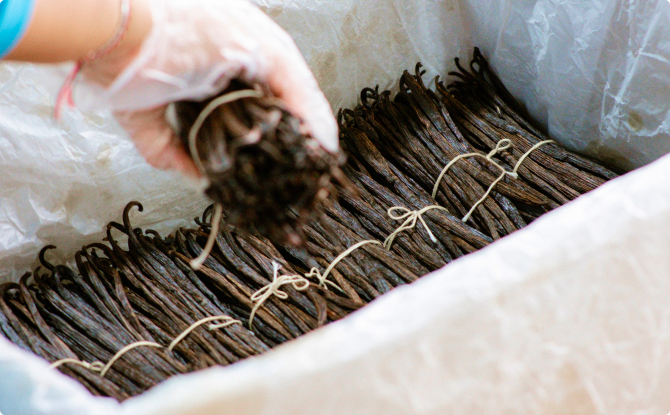
The aroma of a finished vanilla bean can also change during storage.
Packaging, storage temperature, storage duration, and the surrounding environment can influence the condition of the beans over time. Proper storage therefore helps protect the aroma developed during curing and conditioning.
Protecting the beans after processing is part of preserving the aromatic characteristics that have already developed.
Understanding Batch-to-Batch Aroma Variation
Vanilla bean aroma is influenced by a combination of factors rather than a single stage of production.
Variety → Growing conditions → Harvest maturity → Curing → Conditioning → Storage
Each stage contributes to the characteristics of the finished bean.
this means that natural variation in aroma should be considered alongside the other specifications of the product. Aroma, moisture, vanillin, physical condition, grade, and intended application can all be relevant when evaluating a vanilla bean.
The objective is not necessarily for every batch to have an identical aroma, but for the product to consistently meet the required specifications and provide the expected characteristics for its intended use.
At Rendah Vanilla, we pay attention to the journey of Indonesian vanilla beans from sourcing and curing through sorting, preparation, and storage. Each stage contributes to maintaining the natural aromatic character and overall quality of the finished beans.
Explore our Indonesian vanilla beans or contact our team to learn more about our varieties, grades, aroma profiles, and product specifications.